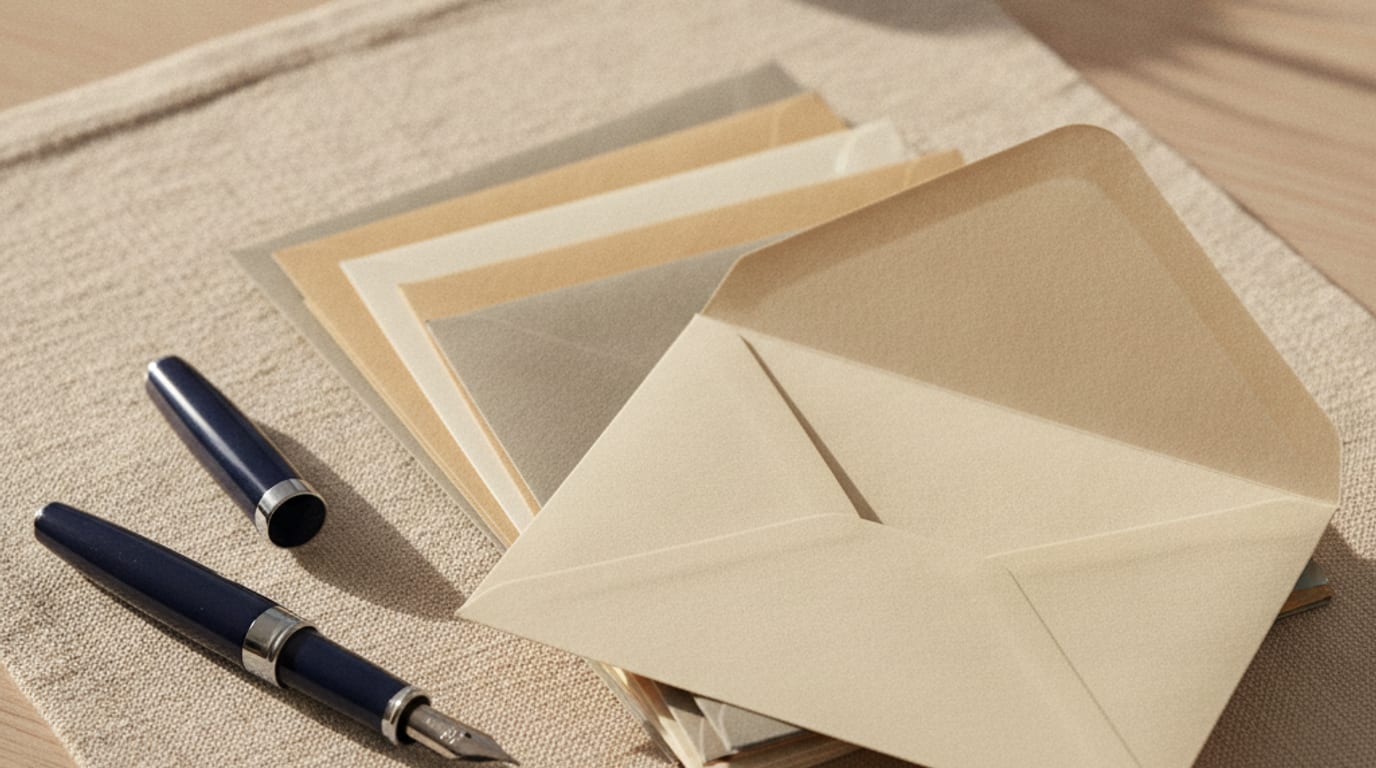
Before anything else: this studio does not address or post envelopes. I design and deliver files. What follows is so you can brief a calligrapher, a printer running envelope addressing, or the friend who volunteered, and so you can check the list before anyone starts writing on card you cannot un-write on.
Nearly every question about addressing is really a question about one of four things: whether you are using two envelopes, how to title people, how to handle a household, and how to say who is and is not invited.
Two envelopes, and what each one is for
The traditional form uses an outer envelope and an inner one. The outer carries the postal address and takes the handling: stamps, sorting machinery, weather, a postal worker’s thumb. The inner sits inside it, unsealed, unaddressed apart from names, and arrives clean.
The division of labour is precise and it is the reason the convention survived. The outer envelope is formal and complete, with full names, titles and the full postal address. The inner envelope is the personal one, and it can drop the surname for people you are close to. It is also where the guest list is stated exactly, which is the part that matters most.
You do not have to use two. A single envelope is completely normal now and nobody will think less of the wedding. What you lose is the clean way of specifying who is invited, so if you go with one envelope, every naming decision below has to happen on the outer.
Titles, and when to skip them
Convention uses honorifics on the outer envelope: Mr, Mrs, Ms, Dr, and the military and clerical forms where they apply. Conventions differ on full stops after abbreviations, so pick one style and hold it across the whole list. A pile of envelopes where half say Mr. and half say Mr looks like a mistake even to people who could not tell you why.
The parts worth knowing:
- Ms is the safe default for a woman whose preference you do not know. It says nothing about marital status, which is exactly why it exists.
- A doctor’s title goes before the name, and if one person in a couple is a doctor, convention puts the titled person first regardless of gender.
- Children under about eighteen are not usually given titles on an inner envelope. First names are the form.
- If someone has told you what they use, use it. A stated preference always beats the convention.
Skipping honorifics entirely is a legitimate choice for a less formal event. Just do not skip them for some households and use them for others.
Couples, in the four configurations you will meet
A married couple sharing a surname. The traditional joint form is one honorific covering both, followed by the shared surname. The modern form names them both. Both are correct. Naming both is what most people under fifty now expect.
A married couple with different surnames. Both names in full on the same line, joined by and, if they fit. If they do not fit, one on each line with no and. Convention puts them in alphabetical order by surname, though putting the person you know better first is widely accepted and nobody has ever counted.
An unmarried couple living together. Both names, and the same rule as above about lines. There is a lingering old convention about separate lines for unmarried couples that has no useful purpose left.
A couple where one is titled and the other is not. Titles are not shared. Write each person’s own.
The point of all of it is that the envelope should not be the place where anyone learns what you assume about their marriage.
Families with children
The convention that solves the hardest problem, which is telling parents whether the children are invited without saying so out loud.
On the outer envelope, the parents’ names only. On the inner envelope, the parents’ names, then the children’s first names on the next line, in age order oldest first. Children named on the inner envelope are invited. Children not named are not.
Two consequences follow. Children over about eighteen who live at home get their own invitation and their own envelope, because they are adults with their own social lives. And if you are using a single envelope, the children’s names have to go on it, in full, or nobody knows.
This is also where an adults-only wedding is actually communicated. Not by a line on the invitation saying no children, which reads as a rebuke. By naming exactly two people on the envelope, and putting a warm sentence about it on the details card for anyone who needs it spelled out.
And guest
Write and guest only when you genuinely mean any guest of their choosing. It sits on the inner envelope, after the invited person’s name.
If you know the partner’s name, use it. Writing and guest for someone whose partner of six years you have met repeatedly is a small insult that lands harder than you would expect. Ask, if you are unsure. Someone in your family will know.
And be aware that and guest is an offer you cannot withdraw. Once it is written, that plus one is coming, and your seating plan needs a chair for a person you have not met.
Before anyone starts writing
A few things that save real money and real evenings.
Buy more envelopes than invitations. Hands slip, a name changes, a wine glass exists. Fifteen to twenty per cent extra is not excessive, and outer envelopes get spoiled far more often than inner ones because they carry more writing.
Freeze the list before addressing begins, and give whoever is writing a clean, final document with names exactly as they should appear. Not a spreadsheet of postal addresses with the names left to interpretation. Every ambiguity you leave in becomes a text message at ten at night.
Do a proof envelope first. One complete envelope, outer and inner, addressed exactly as the rest will be, photographed and checked by two people. That is a ten minute step that has saved entire boxes.
For the wording that goes on the invitation itself, which is a separate set of conventions, the wedding invitation wording guide covers it properly.