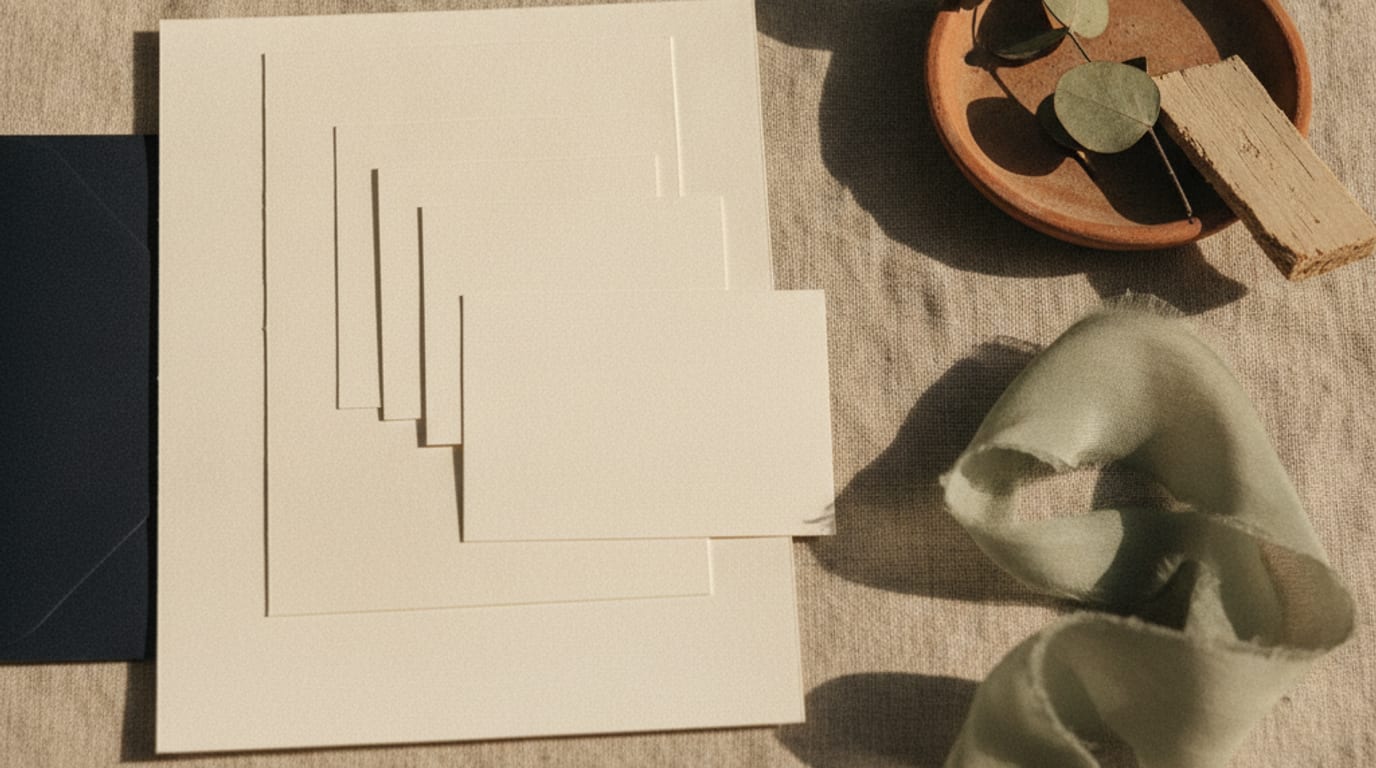
A wedding suite can run to nine separate printed pieces, and most weddings genuinely need four of them. The other five get bought because they appear in a package, not because anyone at the wedding would have missed them.
Here is what each piece is actually for, and the honest test for whether yours needs it.
The four that earn their place
The invitation. Non-negotiable, and it carries less than people expect: who is marrying, who is hosting, the date, the time, the place, and the level of formality. That last one is transmitted by the design rather than stated. Everything practical belongs elsewhere. An invitation crammed with logistics is the most common way a suite goes wrong, and it goes wrong at the first piece.
The details card. This is where the invitation’s overflow lives, and it is the piece that does the most work for the least money. Accommodation, transport, timings for the day, dress code, whether children are invited, your website address if you have one. It is small, single-sided, and it means the invitation gets to stay clean.
A way to reply. Either a card or a line pointing at something online. Which one you use is a real decision with consequences, and it is covered properly in the piece on digital versus print. What matters here is that exactly one method is offered. Two methods split your responses across two places and you will lose count.
Thank you cards. The one people forget to budget for and then need at speed, usually while exhausted. You need one per household that gave a gift, plus a margin, and you want them in the house before the wedding rather than ordered after it. Handwritten on a designed card is the form that has stuck, because a printed thank you message reads as a receipt.
That is four pieces. A great many weddings should stop there.
The five that are usually optional
The map card. Almost always skippable now. Every guest has a phone with better directions than a printed map, and a hand-drawn one is charming rather than useful. The exception is a genuinely hard venue: no address that satnav resolves, an unmarked turning, a farm track, or somewhere with no phone signal on approach. Then a map is not decoration, it is the thing that stops eleven cars arriving late. If that describes your venue, put the directions in words on the details card as well as drawing them.
The menu. Worth it when there is a real choice to describe or a set menu people will read with interest. One menu per two settings is plenty and looks generous rather than sparse. Not worth it for a buffet, where nobody consults a card while holding a plate.
The ceremony programme. Earns its place when the ceremony has structure a guest cannot follow without help: readings, hymns, responses, a language some guests do not speak, or a religious or cultural sequence that will be unfamiliar to half the room. For a fifteen minute civil ceremony, a programme is a piece of paper that gets left on the chair.
Place cards. Needed if you are seating people by name. Not needed if you are seating by table only, in which case the seating chart does the whole job. The reason to seat by name is usually that you have specific pairings in mind, and if you do, place cards are the cheapest possible insurance for a plan you have spent hours on.
The seating chart. Worth it above roughly sixty guests, because below that people find their table by looking. Above it, one large printed chart at the entrance prevents a slow scrum. It is one piece rather than a hundred, so the cost per problem solved is very good.
The pieces nobody puts in the package
Two more turn up late and cause a scramble.
Signage, meaning the small printed things a venue does not provide: a welcome board, an order-of-the-day, a bar sign, a card explaining the guest book, a note about an unplugged ceremony. None of them are stationery in the traditional sense and all of them get made in the last fortnight.
Table numbers, which sound trivial until you realise they need to match the seating chart exactly and be readable from across a room.
Both are worth deciding on at the same time as the rest of the suite, because they share the palette and typography and the marginal effort of doing them together is small. Both fall under day-of paper.
How to decide, quickly
For each optional piece, ask what specifically goes wrong at your wedding if it does not exist.
If the answer is a real failure, guests get lost, guests do not know when the ceremony starts, guests hover in a doorway, print it. If the answer is that the table would look slightly less complete, do not. There will be flowers and glassware on the table and the paper is the least of what is happening there.
Two other things worth weighing. Every additional insert has to fit the envelope, which constrains size, and a suite that outgrows a standard envelope gets more expensive to post in a way that surprises people. And every additional piece is another thing to proofread, and proofreading fatigue is real. The errors I have seen reach print are nearly always on the fifth or sixth piece rather than the first.
What a lean suite looks like
Invitation, details card, one reply method, thank you cards. If the venue is genuinely hard to find, directions in words on the details card. If the ceremony has structure, a programme. If you are over sixty guests, a chart at the door.
That is a complete, well-dressed wedding, and it is roughly half of what a full package contains. The money saved is usually better spent on making the four pieces you do print properly good, on nicer stock and a design that is actually yours, than on five more pieces in the same style.