Two print shops quote your invitations. One comes back at half the price of the other. Nine times out of ten you have not found a bargain, you have described the job differently to each of them, and one is quoting thinner stock, one side, no envelopes and no proof.
A print brief is nine lines long. Written properly it takes five minutes, it gets you quotes you can actually compare, and it removes the phone call where someone asks what you meant by nice card.
The nine lines
Quantity. Say the number and also ask what the next price break is. Print has setup costs that do not care how many you run, so the per-card price falls sharply as quantity rises and then flattens. Two hundred is often barely more than a hundred and fifty. Ask for two numbers and decide with the prices in front of you.
Flat size and folded size. Give both if there is a fold, and be explicit which is which. A 5 by 7 flat card and a card that folds down to 5 by 7 are different jobs on different sheets.
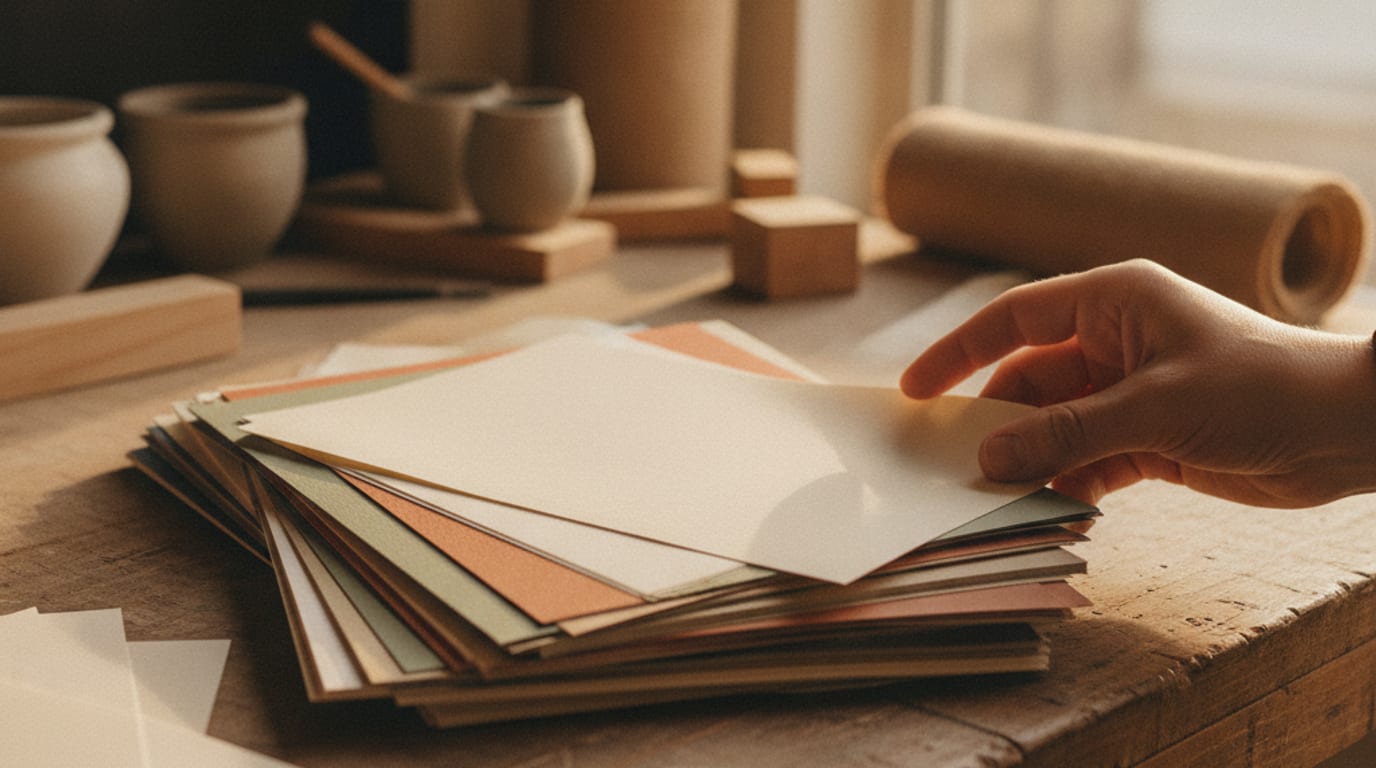
Stock weight. This is where quotes diverge most. Invitations are printed on cover weight card rather than text weight paper. A common invitation card sits around 110 lb cover, roughly 300 gsm, and heavier options exist for a more substantial feel. If you are unsure, ask for samples rather than guessing, and specify by weight rather than by adjective, because thick means nothing on a quote.
Finish. Uncoated, matte, silk or gloss. Uncoated is the usual choice for invitations: it takes ink softly, feels like paper rather than plastic, and can be written on, which matters if anyone is filling anything in by hand. Gloss photographs with a glare and shows fingerprints.
Sides. One or two. Doubling the sides does not double the price, but it is not free either, and shops assume single-sided unless told otherwise.
Folding or scoring. Say what fold, and let the shop score it. A machine scores the card before folding so the fibres bend rather than break, and heavy or dark stock folded without a score cracks along the spine in a visible white line.
Envelopes. Are they included, what colour, and do they match the card size. A 5 by 7 card wants an A7 envelope, at 5.25 by 7.25 inches, and a 4.25 by 5.5 card wants an A2, at 4.375 by 5.75. Ask for at least fifteen per cent spare envelopes if anyone is hand-addressing them, because those get spoiled far more often than the cards do.
Proofing. What kind, and is it included. More on this below, because it is the line people skip and regret.
Turnaround and delivery. Working days from proof approval, not from today, and whether that includes shipping. Ask what the rush option costs even if you do not think you need it.
Proofing is the line that protects you
There are three kinds and they are not interchangeable.
A digital or soft proof is a PDF showing layout and content. It catches typographic errors, wrong dates and misspelled names. It says nothing about colour, because you are viewing it on a screen.
A hard copy proof is a physical print, usually on the actual stock. It is the only way to see how your colours sit on that paper, how the ink weight reads, and whether small type is holding up. It costs money and adds days, and on a job of any size it is worth both.
A press proof is a print pulled from the actual run. Rare and expensive on invitation work.
The rule I would give anyone: soft proof always, hard proof whenever colour matters or the job is large enough that being wrong is expensive. Pale ink on tinted stock, anything with a photograph, and anything where a colour has to match fabric or flowers all qualify.
And read the proof cold. Print it, put it down, come back an hour later, then check the date, the day of the week, the year, the venue name and every proper noun against a source document rather than against your memory. Names of people are where errors survive proofreading, because the eye reads familiar names as correct.
Questions that make quotes comparable
Ask all of these of every shop, and put the answers in a single row each:
- What printing method is this, digital, offset, letterpress or foil? Digital suits short runs and colour photography. Letterpress and foil need a plate or die per colour per side, which is a real setup cost and a real reason a quote is higher.
- Is the price per unit or for the run, and does it include tax and delivery?
- What is your tolerance on quantity? Many shops reserve a small over or under on the finished count, and if you need exactly two hundred you should say so.
- What file format and bleed do you want? Standard is a print PDF with an eighth of an inch of bleed on every side, and the piece on print-ready files explains what that means.
- Do you print in-house or send it out? Not a mark against a shop, but it affects how fast a reprint happens if something goes wrong.
- If there is an error on your side, what is the remedy?
That last one gets an evasive answer surprisingly often, and the answer tells you a lot about who you are dealing with.
What I hand you
Every project here is delivered as a print-ready PDF built to the standard an ordinary print shop expects, with bleed, crop marks, safe margins and fonts embedded, plus flat files sized for texting and stories. What that means practically is that you can send the same file to any shop, and the only thing you have to write is the nine lines above.
I do not print, ship or mail anything, which is deliberate. It means you can use a local shop you can walk into, or the cheapest online one, or the letterpress studio you have been eyeing, without any of it running through me and without a markup on the paper.